Showing posts with label snp. Show all posts

Tuesday, 1 November 2011

On being a woman in politics

A few things have recently been rattling around in my head which concern women in politics; I've been trying to gather some ideas as to why there aren't more of us, and how I might encourage female candidates to come forward. At the same time, I noticed that the launch of the Counting Women In campaign, couldn't miss the outrageous attack on Dr Eilidh Whiteford MP, and I've been enjoying Winnie Ewing's very readable autobiography. I've also been out on the doorsteps for Ken Andrew in Hillhead.

All of these together really say: the culture of politics in the UK is what's at fault. Women don't think it's for them and just disengage. 


Now, obviously that's a generalisation. I'm a woman, and I'm very engaged in politics. I'm prepared to accept I'm a bit odd.


I chapped on a door the other week while canvassing. I had Alexander with me in the pram. A woman answered, I politely introduced myself and my purpose on her doorstep - she shook her head and told me she wasn't interested. I asked why. She firmly asserted that all politicians are just the same. I asked her if anyone from any political party had ever come to see her with a baby in a pram. She thought briefly, admitted that'd never happened, and sent me on my way. 

I'm not sure whether that experience tells me whether I ought to a) leave the wee man at home or b) work on my doorstep pizzaz, but I bet that woman had opinions on all kinds of things. I don't think she believes them to be particularly political - provision of care services, or bin collection, say - but in the end they're determined by politicians. I want women like her to tell me what she wants and why it matters. More than that, I want women who care about issues to join political parties to further that cause. There are all kinds of causes promoted within the SNP, and I will most likely welcome you in.


I'm sure I've said before that I've always felt welcomed as a woman in the SNP, and that remains true. I'm not sure how Labour men treat women in general (not great by some accounts, which appear to be no barrier to reselection), but they're certainly not great at giving SNP women the respect they are due.

I recalled hearing when Winnie's book came out that she had been bullied while at Westminster. The Scotsman's 2007 interview put it thus:

As the lone SNP member in the Commons - at best an intimidating place for an inexperienced politician - she found herself without friends, without party colleagues, without any supporting structures. She was completely alone. She was hundreds of miles from her husband and her children in an excessively macho and very hostile environment. "I was treated as the enemy, I was shunned and despised. It's a peculiar experience to suddenly find yourself hated. At times I did feel terribly lonely, close to despair." 

Reading the autobiography, you really get a vivid picture of the pressure Winnie Ewing was under as an MP on her own. Her every action was scrutinised; if she didn't attend a debate, the other parties would ensure it got in the papers. The nuances of what said were taken apart. She was under political and personal attack from all sides and, even more sinister, stalked by another MP. Interventions by others had some impact, but it must have been a great emotional strain.

What I didn't know was that when Winnie was appointed as an MEP (pre-democratic elections to Europe), the bad behaviour of two particular Labour bullies continued in the European Parliament when she was alone again, deliberately working to ridicule and undermine her for over a year. By the account in the autobiography, this only ended when the President of the Parliament intervened, threatening to have them withdrawn as being "not fit to represent their country and Parliament in Europe".


You might think that, around forty years later, a female SNP MP might expect some kind of change to have occurred in attitudes, as with wider society. Women are accepted in a range of jobs, universities are gaining majorities of female students, there are innumerable opportunities and directions for careers. And then, there's Ian Davidson MP.

Eilidh has written a revealing article in the Scotland on Sunday - I'd urge you to read the full article, but I think this small quote does illustrate the point perfectly:

"It does not matter that all I had done was disagree with the committee. In fact what inspired Mr Davidson’s remark is utterly irrelevant. There is no action, no misbehaviour that justifies the threat or act of “a doing”. We hear too often of women being told they were “asking for it” in justification for intimidation or violence. I never expected to hear that from an MP in Parliament.

But this is not simply an issue of aggression towards woman; it’s about a culture of intimidation and bullying affecting men and women that seems to flourish with impunity in the Westminster world."

The tragedy is that it's primarily through this Westminster lens that the viewing population sees politics and politicians. They see argument, they see confrontation; they see crowds of boorish suits moaning a weary "hear hear". And they switch off. They say "that's not for me".

They don't see a politician arguing the case with a housing association, trying to help a vulnerable tenant. They don't see someone working on a committee, trying to improve a policy that will help improve children's health. They don't see the joy that is presenting prizes to year groups of school students, with the hope that you can encourage them in that tiny second as you shake their hand. They don't know what a privilege it is to be invited into so many lives and homes, to meet with groups and organisations and offer what help you can.

The work of politics should never be that yah boo nonsense that men excel at and so many women hate. More women should be in politics for the fantastic difference they can make every day.


Monday, 24 October 2011

SNP Conference: A Family Affair


I love coming to SNP conference in Inverness; it was the first one I came to in 2003, so I always associate it with that first time and the excitement I felt then. It was really something to be a young activist in the Eden Court, knowing that I shared a belief in independence with so many others. The party remains full of bright, committed, friendly people, and I think it’s one of the SNP’s greatest qualities.

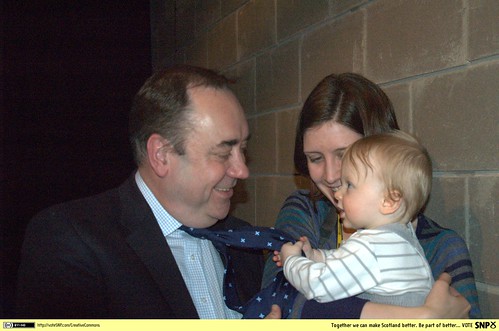
Being in the SNP is being part of a family. Even as I write this blog, on a laptop at the foot of the stairs in the old Bishop’s Palace part of the Eden Court, everyone’s been stopping to say hi and play with Alexander (aka Baby Nat) – Alex Salmond paused before his press interview to say hello (and has since come back and chatted about Casablanca), Auntie Nicola came to compliment him on his shoes, John Swinney was came and played a while with Percy, but Angus Robertson’s magic ear trick was sadly rebuffed. He's going to try again tomorrow!

It was in this friendly vein that Nicola’s speech began with by wishing Allan Angus – a fantastic activist I got to know living in Aberdeen – a very happy 78th birthday, and promising the twinkle-toed charmer a dance at tonight’s ceilidh. Her sincere thanks to activists for their hard work over the years was equally as warm and genuine.

I love to hear people talk about independence and the way that it motivates and inspires them. It’s different for everyone. There’s been a real focus in speeches today on independence as a means of bettering future generations – doing well by our children and their children. Alex Neil spoke of his renewed enthusiasm (not that it needed renewing!) since becoming a grandfather.

Nicola spoke of the aspirations of working class families, who can be sure that their children will make it to University without being inhibited by fees. 

I was speaking to a very proud mum in my ward last week, whose daughter is now in second year at Uni. Her eyes were shining with joy, telling me how well she’s getting on. I’m just delighted to be part of a party that values free education.

I was glad to hear Nicola speak about how much more we could do with the full powers Independence will bring:

“Independence means no longer having to watch our national wealth being squandered by Westminster governments. 

"Independence means having an economic policy suited to our needs, with increased capital investment supporting and creating jobs.

"Independence means having a welfare system that can tackle the scourge of child poverty. It means not having to put up with Tory policies that will consign tens of thousands of our children to a life of deprivation.

"Independence means deciding for ourselves whether to send our young men and women into conflict. And it means knowing that we need never, ever, again be dragged into an illegal war. 

"Independence means getting to decide our own priorities. 

"And, delegates, independence will mean no longer having to put up with the obscenity of Trident nuclear missiles on the river Clyde. 

"Delegates, Our case for independence will be based on the simple but powerful belief that, as a country, we are better placed than anyone else to take the right decisions for our future. 

"That with the talents and skills of our people, and control over our own resources, we can build a more successful, prosperous and socially just country. 

"It's a message of empowerment and responsibility. A message of hope and possibility.” 

This, as delegates, we already know in our hearts and our heads. I’m just loving taking that message out on the doorsteps, and those I’ve spoken to the doorsteps have been keen as well.


Sunday, 27 March 2011

Illiterate Labour


My mum passed on to me this rather poor piece of campaign literature from Labour in Clydesdale. Labour are claiming to support the apprenticeships and the Council Tax freeze which they voted against, present falsehoods about NHS cuts, are apparently now against tuition fees which they introduced in government, and are promoting the 'two week cancer guarantee' (sounds a bit scary, but relates to waiting times, which have actually fallen under the SNP's stewardship).

The real sweetie in the letter is in the fourth paragraph. I've noticed before that Labour have a bit of a problem when it comes to literacy. This letter is just embarrassing - two typos in the paragraph which calls for bringing literacy teachers 'back' into schools for goodness sake. The simplest spell checker could pick that up. 

Furthermore, I'm not sure where these imaginary literacy teachers went, or how something which never existed can be brought back; as ever for Labour, the facts just get in the way of a nice wee bit scaremongering. 

If this is Labour's standard of campaigning, I do hope they contact lots of people...  

Wednesday, 16 March 2011

Skittish Labour's Council Tax Confusion

Things really must be getting desperate over at John Smith House - Labour's recent u-turn on the Council Tax demonstrates how few ideas they have for governing Scotland. 

At Full Council back on the 28th of October, Glasgow City Council Treasurer James McNally proposed a motion saying that a continued freeze on Council Tax was "not sustainable" and called on the Scottish Government to "restore the flexibility to councils to set a reasonable level of Council Tax without suffering financial penalty". All very interesting euphemisms for increasing taxes, I'm sure you'll agree. 

Glasgow Labour were far from the only part of that party calling for an increase in Council Tax, however. Iain Gray had made remarkably similar comments in the Herald on the 3rd of October:

“It does not look to us that the council tax freeze is sustainable... They (local authorities) have to have as much flexibility as possible."


Labour were against the freezing of Council Tax, they said, due to the alleged threat to public services. That threat, if it ever existed, seems to have vanished like yesterday afternoon's snow flurry over Glasgow. 
 
In the Scottish Parliament, they claimed various catastrophes would strike: 

David Whitton (Strathkelvin and Bearsden) (Lab): "The cost of the unfunded council tax freeze does untold damage to local authority services, just so the SNP can claim to have helped the average band D council tax payer to save a few pence a week."


Helen Eadie (Dunfermline East) (Lab): "Campaigners in Scotland warned that people would die as a result of the cuts, which councils blame on the SNP Government's council tax freeze."


On the 30th October 2010 Des McNulty made a conference speech claiming that:

"The consequence of freezing the council tax is cuts in our children’s education"


Where do all these spokespeople, Councillors and MSPs stand now? Do they still believe that the Council Tax freeze, which has  helped hard-pressed householders (including those on fixed incomes such as pensioners), is dangerous? Or did they never really believe that in the first place, prepared yet again to put the party political interest before the needs of ordinary people? I think they owe Scotland an apology, and at the very least an explanation.


Monday, 14 March 2011

Conference Weekend

DSC_0361

Really enjoyed SNP campaign conference over the weekend - not least as it was in Glasgow so I didn't have the hassle and expense of travel and accommodation! 

It's great arriving at conference, going into the venue to meet so many people you know. The SNP feels like an extended family to me - even though we are now the largest political party in Scotland with over 16,000 members, conference is like a big reunion, full of smiles, hugs, promises to catch up, and the odd dotled old auntie or uncle who you love despite their various eccentricities (I'm naming no names!). 

It's a bit different now I have Alexander - Joe's parents were visiting and they looked after him on the Saturday morning; everyone wanted to know where he was and why he wasn't attending! I put the opportunity to good use to pop around some of the exhibitor stalls, speaking to the Fire Brigades Union, Shelter and Action for Children among others. It's important to get the chance to find out what their key issues are, and to pass on some of the issues going on in my ward.

I also got called to speak on a resolution calling for our Government to re-introduce the policy of minimum pricing for alcohol. I've submitted speakers cards a few times at conferences past, and hadn't expected to be called this time either - so I was a bit surprised to hear Bruce Crawford call my name! I highlighted the issue of Labour in Glasgow City Council being implored by the Director of Public Health to support minimum pricing, but instead doing the equivalent of putting their hands over their ears and going 'lalallalala, can't hear you!'. It still drives me nuts that they would make such an important public health issue into a political football.

Joe dropped Alexander off just before his namesake (joking, really!) got up on the platform for the keynote speech. It was one of the finest speeches I've ever seen Alex Salmond deliver. He presented a real, tangible vision, calling on Glasgow as the former workshop of the empire to create a "new empire of the mind".

"We intend that this nation - this Scotland - researches and develops, constructs and fabricates and then supplies and maintains the new green energy systems that will dominate this century. 

We intend that this city of Glasgow, marine engineers the 21st century just as it once led the marine engineering of the 19th - when ships from the Clyde carried a nation in their hold."

"The green energy revolution in which we are embarked is the right course. It is the right course for Scotland, for Europe and for the planet. We shall be the green energy powerhouse of the European continent and a world leader in many of the key technologies."

Alex also made it clear how little the other parties have to offer, and their narrow,  vested interests; by contrast, we can really speak to and for all of Scotland.

"We speak for the poorest Scots the low paid families and pensioners who have benefited most from our freeze on the council tax and our ending of prescription charges.

We speak for the young delivering the 25,000 apprenticeships that Labour voted against, lowering class sizes and keeping education free

We speak for the vulnerable – we are protecting them with 1,000 extra police officers who have led crime to a 32 year low.

We speak for the aspirational.  The millions of Scots who want a better future for themselves, their children and their grandchildren.

We speak for those who want to start their own business. The small business bonus has cut or abolished rates for 80,000 small businesses. Labour voted against that as well.

We speak for the communities of Lossie and Leuchars who have served this country well and expect loyalty not betrayal in return.

Delegates we speak for all of Scotland and all of Scotland needs the Scottish National Party"

This last part of his speech is almost like poetry, with some great turns of phrase.

We have the best team on the park and we govern for the whole of Scotland.

But politics is nothing without a bigger vision 

In government, much is in the day-to-day 

But you must still keep an eye on the horizon 

On the big prize

For us that prize is independence 

But independence is a means to an end 

That end is a society safe, happy, healthy 

Confident in its skin 

A global citizen acting to help the world where it can 

Because the map makers’ ink is becoming smudged on every border 

Globalism, the rise of the knowledge economy, the big economic changes, the great environmental challenges

All point to a world where the responsibility of the nation 

Is to raise people who are responsible to the world 

And the definition of a nation is a community of people with a shared commitment to their culture and to their children 

By having a strong sense of ourselves 

That allows our new communities from Asia to know what it meant to be Scottish 

And to give them something to join, to be part of 

And that sense of self is built on community 

On the shared value of helping each other out, lending a hand

On a sense that society should try to be as equal as it can be 

That is what we value and what we think is the purpose of government. 

To the rights of the ordinary to triumph over vested interests.
In our capital city of Edinburgh there stands a monument to Thomas Muir and his fellow friends of the people

His memory should cast a beam across the work of every civil servant in the Scottish Government and every Minister – because the monument to Muir and his fellows revolutionaries spikes out of Calton graveyard like a shaft of stony light across from St Andrews House.

And this monument contains Muir's own vision:

“I have devoted myself to the cause of The People. It is a good cause - it shall ultimately prevail - it shall finally triumph.”

And his message was not just for this place, but for every place

For his spirit, for Robert Burn's spirit, Jimmy Reid’s spirit, our spirit,

It is for the common weal.

The rights of man - and of women

And the legitimacy of the ordinary over the powerful

This party has travelled a similar path

This movement, this nation, has been patronized, talked down, told it wasn't good enough.

And yet this party has risen from a few MPs and a land without a parliament, to a Scotland with a parliament, and an SNP government

We never lost the strength of hope - and we fought on to triumph.

But we, in our mix of the national and the international, of the personal and the political, we fought not to govern over people

But for the people to govern over themselves

It is for that reason and that reason above all that we are the Friends of the People of Scotland and for that reason we shall prevail."

I was very proud indeed of Alexander, who sat on my lap, bright, happy, quiet and attentive all the way through the speech. He repeated the trick for John Swinney on Sunday, but was a bit more restless for Nicola. I can only guess it's because he sees Auntie Nicola a lot more often!
 

Wednesday, 9 February 2011

Budget passed, Labour out of step!

I'm just rushing out to my surgery, but I'm delighted to hear the Scottish budget has passed. Labour failed again to rise above their petty politics for the greater good of Scotland. The other parties managed to find common ground. 

Take it to the doorsteps: Labour do not support the following:

A further £11.5 million to create 25,000 modern apprenticeship places - a 
record high for Scotland;
 
Abolition of prescription charges and the Council tax freeze;
 
Continuing Small Business Bonus Scheme;
 
Invest an additional £15 million across 2010-11 and 2011-12 in funding 
for college bursaries; 
 
1,000 additional police officers;
 
£10 million support for SME employment creation – focused on new 
starts, sole traders and small firms to take on new employees by 
assisting with employment and recruitment costs and assist with 
exports;
 
Provide 7,000 flexible training opportunities for SMEs - 2,000 more 
than originally planned in the draft Budget;

Invest £8 million to provide enough funding for an extra 1,200 college 
places;

Maintain educational grants (EMAs) for pupils and college students 
most in need which were cut south of the border;
 
Extending the Living Wage of £7.15 to all agencies the Government is 
responsible for and Scotland's NHS; 
 
Guarantee a probation place for every newly-qualified teacher and 
provide enough teaching jobs for every post-probationer in 2011-12;

New Early Years and Early Intervention Fund, with start-up funding of 
£5 million;
 
£2m Freight Facilities Grant;

£1m Post office Diversification Scheme;
  
£12.5 million for Urban Regeneration Companies – increase of £6 million 
on the Draft budget;
  
£16 million further investment in Housing;

Protect Health Spending and continue provisions for free personal care;
 
£2.5 billion infrastructure investment programme;
 
Infrastructure Commitments such as the new Forth crossing, New South 
Glasgow Hospitals project and school building programme;

£70 million Renewables Infrastructure Fund – over four years;
 
£48 million support for energy assistance package and Home Insulation 
Scheme. 
 
All this done in spite of £1.3 billion in cuts started under Labour.

Tuesday, 8 February 2011

Oh, what tangled webs they weave...

I found Newsnicht unusally satisfying last night. It was something of a relief to see that finally, finally, the truth has caught up with the Labour Party in Scotland and bitten them on the bum. 

I've seen it often enough - scaremongering over bus passes when we actually expanded the scheme, saying Glasgow is 'ripped off' when we have the Commonwealth Games, M74, Southern General, the new rail line linking the East End to Edinburgh and new housing  for social rent popping up all over the city (and much more besides!).

The Megrahi affair was particularly distasteful, attempting to make party political gain on the back of Scotland's justice system and the families of the Lockerbie dead. 

All the time, when they had been notching up the fury against Kenny MacAskill for taking the legally and morally correct decision to release Al Megrahi, their counterparts in London had been bending over backwards for some time to help Libya secure his release by any other means. 

Other bloggers out there have made particularly good points on the matter, so I feel it best just to point you in their direction: Joan, Moridura, Pop, and Peat Worrier. This video of the hapless Richard Baker on Newsnicht is a must-watch.

"That leaves you with only three positions; either you knew and have been completely hypocritical, you didn't know and were completely sidelined by London in this or you knew and thought that the Prime Minister, the foreign secretary, the entire Government were unprincipled in the decision they were making and you would stand against them. Which is it?"


Sunday, 2 January 2011

Iain Gray - not a statesman (part two)

I missed the final FMQs of the year, but I see from today's Scotland on Sunday that Iain Gray has been at it again. Not content with offending Ireland and Iceland, he has recently been using Montenegro as a means of showing how terrible independence would be for Scotland. 

This is same Iain Gray who, in a recent interview with the Scotsman, stated that:


"What I think the Scottish people don't need at a time like this is a politician like Alex for whom it sometimes seems that photo opportunities in silly hats are more important than taking the serious and hard decisions that are needed for Scotland"


Because picking on other nations in order to do down your own country is mature, grown-up, thoughtful and serious politics. Causing diplomatic incidents just to make a point.


Mr Gray's argument is put thus: 


“...the SNP website where it includes Montenegro: ‘Montenegro shows us just how easy it can be to become an independent country. 40 days is all it took for Montenegro to regain her freedom. It could be Scotland next.’ 40 days, plus two world wars, the Balkan conflict, ethnic cleansing, a war crimes tribunal and a UN peacekeeping operation."


I doubt very much that the people of Montenegro feel their journey to regain their independence was easy, but the process - which I believe is the point - was indeed relatively simple. Unionists like to argue that we would be bogged down for years debating who gets what after independence; if both sides are willing to be mature and sensible, there's really no reason why this should be the case. 


While it's good to see the exposing of Iain Gray's deficiencies as a politician (and indeed as a adult human being), the Scotsman itself has been caught wanting in this whole affair - as the letter published from the Montenegro Charge D'Affairs Ms Zivkovic reveals:

 
"I feel compelled to respond to your report (24 December) which describes Montenegro as "the war-ravaged country". Montenegro, in fact, was the only former Yugoslav republic where neither war nor devastation took place in the last decade of the 20th century.
And not only was there no ethnic cleansing in the country, as proposed by Scottish Labour leader Mr Iain Gray in the same article, but Montenegro opened its doors to the refugees of all nations.

At one point in 1999, refugees made up one fourth of the population of Montenegro, when - in just two days - we provided shelter to more than 100,000 Albanians fleeing from Kosovo.

And, crucially, Montenegro was the first country in the Balkans that renewed its statehood by peaceful means in a democratic referendum organised in full co-operation with the European Union.
 

Marijana Zivkovic
Embassy of Montenegro
London"


Tuesday, 23 November 2010

Answer Time

I got this response on the 16th of November, only just getting the peace and quiet to post it! Interesting I suppose that it's from an actual person this time. I also noted during last week's show in Wales that there seemed to be a softening of the stance taken on the Glasgow show. Progress, I hope, but too late for Scotland!


"Dear Ms Thewliss

Reference number: CAS-390462

Thanks for contacting us regarding ‘Question Time’ broadcast on the 4 November.

We understand you were concerned that the programme discussed American politics after David Dimbleby reminded Scotland's Deputy First Minister Nicola Sturgeon about the programme’s wider UK audience.

‘Question Time’ approaches every edition with a broad and wide-ranging remit, covering the major events in the political landscape during the week. We travel across the UK, and local examples are often cited by audience members to highlight a wider point. However this does not mean that the programme seeks to discuss only regionally-specific matters.

On this occasion the panel were expressing their sentiments on the announcement of the most recent GDP figures for the UK. During this discussion Deputy First Minister Sturgeon said “there’s another point on growth, it’s important for a Scottish audience”.

David simply interjected to remind Deputy First Minister Sturgeon that not only was she speaking to the studio audience in Glasgow but also to viewers across the UK.

One of his key roles as chairman is to keep panellists to the specific question under discussion and not to potentially divert to other party political points. He was not stopping her from raising a regional/national point - as has been heard in recent weeks with the al-Megrahi case or the Corus steelworks matter - but simply reminding her of the core programme need for this point to resonate with and be relevant to a UK-wide BBC One audience.

We would like to assure you that we’ve registered your comments on our audience log. This is the internal report of audience feedback which we compile daily for all programme makers and commissioning executives within the BBC, and also their senior management. It ensures that your points, and all other comments we receive, are circulated and considered across the BBC.

Thanks again for contacting us.

Regards

Gemma McAleer"

Friday, 5 November 2010

Question Time again

Well, since I'm in the mood for such things, I sent in a complaint on this evening's Question Time. I thought I might as well be consistent!


"During last week's edition of Question Time, Nicola Sturgeon was reminded by David Dimbleby that the programme was for a UK audience. This week University funding in England was discussed at length and it was not made clear that the discussion had no relevance to Scotland, where tuition fees have been abolished.

Later in the programme, there was a discussion on the politics of the USA. While this may have been topical, it certainly would not have been directly relevant to the daily lives of the UK audience. It seems entirely nonsensical to deny debate on Scottish issues, where this is at present a constituent part of the United Kingdom, but then debate at length the implications of the midterm elections in another nation some distance from our shores.

I look forward to your explanation for pursuing these issues in your 'UK-wide' programme."


Friday, 29 October 2010

Questioning Question Time

I was so irritated by Question Time last week, I actually took the bother of emailing them rather than just grumbling as usual.


"I was deeply offended and disappointed by last night's edition of Question Time, in particular by Mr Dimbleby's quite deliberate marginalisation of issues of importance to Scotland.


It seems to me that by moving Question Time to various locations allows viewers to gain an insight into topical debates in the Nations and regions which make up the United Kingdom. I would find it interesting to hear what is going on in Wales, for example, and feel that for viewers elsewhere, it might be interesting to hear what is being debated in Scotland.

This week Scotland saw a significant change in the law, arguments over priorities in education, the proposed closure of military bases and maintaining of aircraft carrier contracts; meaty issues all. None of these were discussed.

Furthermore, hosting Question Time around the UK gives an opportunity to hear from Scottish politicians from a range of parties (including the Greens, who have been represented in the Scottish Parliament for eleven years now) and from the Scottish Government.

Quite disgracefully, Nicola Sturgeon was consistently interrupted by David Dimbleby, and was not allowed to present the positions of the SNP and the policies of the Scottish Government. The SNP have a serious contribution to make, which was not reflected in the manner in which Nicola Sturgeon was treated by Mr Dimbleby. Comments by other panellists also struck me as having more than a hint of patronising sexism, which went unchallenged by the host.

The issue of Megrahi was dropped into a debate quite purposefully and deliberately by Mr Dimbleby, who then called for comment by the four other panel members but not Ms Sturgeon, whose Government took the quite legally and morally correct position to release a dying man. The last time Question Time was in Scotland, the issue was also raised, seemingly with the purpose of attempting to embarrass the Scottish Government. It was not a 'current' issue in the press, or a matter which required further debate; the decision has been made and is final! I find it quite unacceptable that your programme makes it seem as though this is the one and only issue significant in Scotland.

I find it unacceptable that Scottish issues have no outlet in UK-wide programmes such as Question Time. Scottish issues are never debated when programmes are held outwith Scotland, and when the programme is held in Scotland, apparently we're not allowed to debate Scottish issues then either.

Health, education, crime, and a whole host of other issues irrelevant to devolved parts of the UK are debated week in week out on Question Time without proviso or clarification. It's about time that the rest of the UK got a proper opportunity to glean information about what is important in Scotland, Wales, Northern Ireland and each of the English regions. If hosting in different locations is not to be an opportunity to do this, there's little point in the show moving from London at all.

I hope for better, but thus far and increasingly more often, I am left disappointed.

Kind regards,

Alison Thewliss"


The response just arrived, looking remarkably similar to that issued to Joan McAlpine:


"Dear Ms Thewliss

Thanks for your feedback regarding ‘Question Time’ broadcast on 28 October 2010.


We appreciate some viewers felt chairman David Dimbleby showed anti-Scottish bias by reminding Scotland's Deputy First Minister Nicola Sturgeon about the programme’s wider UK audience.


‘Question Time’ approaches every edition with a broad and wide-ranging remit, covering the major events in the political landscape during the week. We travel across the UK, and local examples are often cited by audience members to highlight a wider point. However this does not mean that the programme seeks to discuss only regionally-specific matters.


On this occasion the panel were expressing their sentiments on the announcement of the most recent GDP figures for the UK. During this discussion Deputy First Minister Sturgeon said “there’s another point on growth, it’s important for a Scottish audience”.


David simply interjected to remind Deputy First Minister Sturgeon that not only was she speaking to the studio audience in Glasgow but also to viewers across the UK.


One of his key roles as chairman is to keep panellists to the specific question under discussion and not to potentially divert to other party political points. He was not stopping her from raising a regional/national point - as has been heard in recent weeks with the al-Megrahi case or the Corus steelworks matter - but simply reminding her of the core programme need for this point to resonate with and be relevant to a UK-wide BBC One audience.


Thanks for taking the time to contact us.

Kind Regards

BBC Audience Services"


I despair.


I spoke to Tory Councillor David Meikle yesterday, and he described the long conversation he had with a member of the Question Time team before getting selected to attend. He's not a nat by any stretch of the imagination, but felt there were plenty of Scottish issues to discuss, all of which were ruled out by the member of BBC staff he spoke to. A letter in today's Herald describes a similar conversation.


This evident anti-Scotland bias is unacceptable, and it has to stop.


Tuesday, 26 October 2010

Battling the booze

I attended a meeting last week which was rounding off a local alcohol campaign in my ward. There was a lot of partnership working between GCSS, Strathclyde Police, Land and Environmental Services, Health and Licensing Officials and youth providers to crack down on public drinking and youth disorder. The results of the work are quite impressive.

Over the period of the initiative, from April to October, there was a reduction in anti-social behaviour by 11%, and a reduction in youth disorder by 22%. Sixty-eight drinking dens were identified and removed, and over 450 visits were made to licensed premises to ensure that under-aged and agent selling was being challenged and shop staff were aware of their responsibilities.

Most impressive of all was the haul of alcohol confiscated from people drinking in the street - a total of 467 litres! This was broken down as over 250 litres of cider, over 100 litres of beer/lager, over 90 litres of wine (of which, I understand, a particular tonic wine forms a part), and over 30 litres of spirits.

I wouldn't want to claim that my ward is representative of Scotland as a whole or al fresco drinkers as a group, but it certainly seems that of those people likely to be caught drinking outside and causing anti-social behaviour, most are drinking low cost, high volume drinks - cider and beer. These are the drinkers and the drinks that minimum pricing would target, and by this evidence rightly so. That particular wine is a problem but, in the inner East End of Glasgow, it's certainly not the problem Labour claim it is.

Partners are now discussing the actions which were taken over these past months, and what aspects they can afford to pursue. There is still much work to be done.

Saturday, 16 October 2010

SNP conference

Lack of much phone signal in Perth Concert Hall has put the hems on my idea of live tweets from SNP conference, and despite being told that there was wifi signal in the hall, my laptop isn't really entertaining the idea of connecting to it. So much for politics in the web age!

Anyway, I'm now into my second day of conference, having been to the Strathclyde Fire and Rescue Board on Thursday instead. There were a few important papers on Finance coming to the Board, which I felt warranted some questions. While we all know that cuts are likely, I felt that taking any decisions before the full implications are known is a wee bit rash. The (Labour) majority on the Fire Board were differently minded.

Yesterday was pretty good - excellent speeches by John Swinney (more of which later) and Kenny MacAskill, and some interesting resolutions on PFI, Business Rates, Banking Reform, Public Finance, Languages, Diego Garcia, and Afghanistan, and topicals on Royal Mail, pensions and the Commonwealth Games. I was hoping to speak on the latter but time was getting tight and wasn't taken. Hopefully will get to speak at some point during the weekend!

I also got to see the new party broadcast, under the slogan bepartofbetter.net Funky music, encouraging and positive concept; negativity is not going to inspire the Scottish people, but the idea of pulling together to work our way out of cuts is one I believe has some traction.


Saturday, 2 October 2010

Iain Gray - not a statesman!

Something to consider for the Scottish Parliamentary elections next year: Iain Gray isn't much of a statesman.


Regardless of whether the Scottish Parliament is independent or not, it's surely a matter of common courtesy and respect not to demean other nations for party political gain. Again and again, Labour politicians are more than happy to slag off other nations in order to demonstrate how poor, wee and stupid they believe Scotland and her people really are.


The trouble is, these other nations might hear Mr Gray. They might not be too impressed. If Mr Gray was in charge of Scotland, such public denouncements might even result in damage to Scotland's trade and diplomatic relations. After all, would you want to deal with a man who clearly has no respect for you?


Mark Coleman, the Economics Editor with NewsTalk in Dublin and columnist with the Sunday Independent, can be heard on the iPlayer (around sixteen minutes in) giving his rather pointed reaction to Iain Gray's comments at this weeks FMQs. He says:


"...Looking at 10 years of Labour leadership has left Scotland unfortunately with a GDP per capita that's significantly lower than the EU average and the EU, so perhaps the credibility of that remark should be filtered through that simple fact.

"All I will say is that Ireland's population is a million higher than it was 14 years ago; we have a quarter of a million more employed, a quarter of a million more in work than we did a decade before; we have a quarter of a million people in Ireland now working from other EU countries, a GDP per capita 30% higher than the EU average...

"...Have we taken a blow, we certainly have. Are we still standing, we absolutely are."


Labour's argument is painfully backwards - it's obvious that despite their current difficulties, Ireland isn't interested in rejoining the UK, Iceland isn't going back under the wing of Denmark, and for that matter none of the small successor nations of the former USSR are looking to cede their hard-won sovereignty back to mother Russia. Yes, some nations are facing hard times but none of them are questioning their independence.


Managing your own finances is just one of the many things that normal independent nations do every hour of every day. Scotland is not uniquely incapable of doing the same, despite what Labour would have us believe. The main barrier to independence is Scotland's own self-doubt.


Until independence comes around, we need someone to fight Scotland's corner, to win friends and gather as much support for the development of our nation and our economy. Building solid relationships with our neighbours and other smaller independent states is a good start.


I've decided to reproduce Iain Gray's questions from FMQs. You can judge for yourself whether this man is capable of leading Scotland.


Iain Gray: It was one of those clear autumn mornings this morning when we feel like we can see for miles. Where should we look for the First Minister's arc of prosperity today: Australia, New Zealand, Spain, Iceland or Ireland?


The First Minister: I think that we should take a variety of international examples in following best practice in Scotland. As Iain Gray knows, I recently visited Norway and made a number of announcements about renewable energy and collaboration in Scotland. One thing that particularly impressed me as I visited Norway was the £200 billion oil fund that that country has accumulated by having access to its own natural resources. Would that Scotland had been in the same position over the past 30 years.


Iain Gray: The fact of the matter, of course, is that Norway's oil fund has been built up because Norway—


Members: Is independent.


The Presiding Officer (Alex Fergusson): Order.


Iain Gray: It is because the Norwegian state still owns its oil and gas industry. If the First Minister is proposing to nationalise the oil and gas industry, he should probably tell us. [Interruption.]


The Presiding Officer: Order.


Iain Gray: It is no surprise that when the First Minister is asked about Ireland nowadays, he talks about Norway. The First Minister once said:

"I am sure that most of Europe's Finance Ministers would give at least one limb—possibly more—to have Ireland's problems".

Today, the cost for Ireland of bailing out the Anglo Irish Bank reached €34 billion. The finance minister warned that its failure would destroy Ireland's economy.

Which limb would the First Minister give to have that problem?


The First Minister: Iain Gray will forgive me if I correct him on his understanding of the Norwegian oil fund. The Norwegian oil fund was built up from

Col 29153

revenues from oil—not just from Statoil, the Norwegian state oil company, but from all the major oil companies exploiting oil in the Norwegian sector. It is unbelievable! I thought hitherto that Iain Gray opposed the concept of Scotland benefiting from its own natural resources because he wanted Westminster to have them. I now realise that it is because he did not even understand the proposition. I will send Iain Gray a paper on the Norwegian oil fund. Given that so much is changing in Labour and given that new Labour is buried, despite Iain Gray's attachment to it, if all the policies are changing, who knows, maybe Labour will be in favour of an oil fund before long.

I point out two things to Iain Gray. First, on direct capital investment in the Scottish banks, currently the Treasury is making a profit, given the current share price of Lloyds and the Royal Bank of Scotland. [Interruption.] That is a fact nonetheless. Secondly, Ireland, like many countries, has substantial economic problems at present, but I note that its wealth per head is actually higher than that of the United Kingdom.


Iain Gray: It was an Irishman who said that there are none so blind as those who will not see. Ireland is teetering on the edge of collapse, and Scotland's banking sector is 10 times the size of Ireland's. The Royal Bank of Scotland alone had a balance sheet 15 times the size of the Scottish economy. The investment in saving those banks was £470 billion. Will the First Minister admit that, in an independent Scotland, RBS and HBOS would have collapsed and the Scottish economy would have collapsed with them?


The First Minister: Just as Iain Gray confused Statoil with the Norwegian oil fund, he is confusing capital injections into banks with general support for the financial and monetary system. The capital injection into the Scottish banks is now making a paper profit for the UK Treasury.

Iain Gray says that the Irish economy is on the brink of collapse. Judging from Labour's conference, I thought that it was the UK economy that was on the brink of collapse. The Labour Party has argued, with some justification, that the UK Government is risking a double-dip recession because of an approach to an austerity programme that goes too far and too fast in its cuts in public spending. I agree with that proposition on the basis of the evidence from Ireland. If that is the argument that Iain Gray is putting forward—that, unless an alternative policy programme is agreed, the UK risks moving into a double-dip recession—does that not support the argument that we should look to European countries such as Norway, which have avoided that by mobilising their natural resources to power

Col 29154

their economy forward? I would that we could do the same in Scotland.


Iain Gray: Support for the Scottish banks was £470 billion—£70 billion capital injection, £100 billion special liquidity scheme, £100 billion credit guarantee, £200 billion asset protection scheme and £10 billion in fees. The Government may get some of that back, but if it had not had it at the time when it was needed, we would have suffered the consequences. Everyone in Scotland knows that, in a separate Scotland, our two biggest banks would have gone and, with them, all the jobs, savings, pensions, mortgages and salaries. Everyone in Scotland knows that we would have tipped over the edge on which Ireland teeters today. Is Alex Salmond the last man in Scotland who does not realise that his personal obsession with independence is daft, deluded, deranged and downright dangerous for this country?


The First Minister: Alex Salmond realises that it is only with economic powers for this Parliament and this Government—the economic powers that would be delivered by independence—that we will have an alternative to 10 years of despair and public spending cutbacks in the United Kingdom.

As they also say in Ireland, if I was going there, I would not start from here. That applies to Iain Gray's questions. He has confused the capital injection into the banking sector that is taking place in Ireland at the moment with general financial support for a monetary system. The two things are entirely different. It is not me who claims that there is a profit to be gained from the capital injection into Lloyds and RBS; that is in the Treasury documents—not just the Treasury documents of the new coalition, but the Treasury documents that were produced by Iain Gray's old boss, Alistair Darling.

Ed Miliband evoked a new atmosphere of consensus at the Labour conference when he said that he would not attack policies to restrict short-term sentences and say that people were being soft on crime. As Ed Miliband moves in a sensible political direction and supports the SNP Government's policy on crime, which has been so successful, will not Iain Gray eventually realise, in that changing atmosphere, the obvious, inarguable point that only in our having economic powers and growing the Scottish economy is there any alternative to being at the mercy of coalition cutbacks, two thirds of which were started by his own party?