"Culture and External Affairs Minister Fiona Hyslop confirmed the Scottish Government has allocated more than a million pounds from its 2011/12 budget for work on the Theatre Royal and Glasgow Royal Concert Hall.
Scottish Opera will receive £605,000 to progress plans to upgrade the Theatre Royal while the Royal Scottish National Orchestra (RSNO) will receive £413,000 towards the redevelopment of its new home at the Glasgow Royal Concert Hall.
Ms Hyslop said:
"Hosting the Commonwealth Games in Glasgow is a fantastic opportunity to create a lasting legacy for the people of Scotland.
"The Scottish Government's funding commitment will enable Scottish Opera and the RSNO to take the first steps with the redevelopment of these venues, enhancing the programme of cultural activities on offer in 2014 and beyond and supporting Glasgow's continued status as UNESCO City of Music.
"These projects form part of the major regeneration work going on in Glasgow in preparation for the Commonwealth Games, which includes more than £1 billion of infrastructure projects which are already helping generate significant economic benefits for Glasgow and the whole of Scotland.
"The Scottish Government is passionate about delivering a successful Games which is not only a spectacular sporting extravaganza but which also showcases Scotland's world-renowned culture and creativity. Our intention is to make a further substantial capital contribution to the overall construction costs of the Theatre Royal Redevelopment and the Glasgow Royal Concert Hall projects."
My view on the world, as a Councillor, mother, and campaigner for Scottish independence. Welcome.
Wednesday, 23 February 2011
More Scottish Government money comes to Glasgow!
Monday, 30 August 2010
Fruitless!
I know from visiting schools and nurseries in the city, and from the various gala days over the summer that children in the East End are now getting used to the idea of eating fruit regularly; they know and like the taste. Organisations like East End Kids 'n' Co, who provide fruit kebabs and smoothies at fun days, could barely keep up with the demand!
There are always new mouths to feed though, and while this current crop of youngsters have adopted healthier habits, those who follow need to be encouraged too. Sadly, not every parent will choose to have fruit at home, or can afford it; parents might not be in the habit of eating fruit themselves. Schemes such as this can make a difference, and use the 'pester power' of children for good.
The really frustrating thing is that, according to the Herald this morning, the SNP Scottish Government, anticipating that free oranges could be squeezed by budget cutbacks, applied to the EU to be part of a free fruit programme. Success looked likely until Westminster indicated their intention to claw back 72p of every £1 we would save by participating. This is absolutely farcical; in these circumstances, the Scottish Government is penalised for trying to be innovative and fiscally efficient. EU money is out these, but under devolution it doesn't pay us to apply for it.
Independence would allow us the freedom to manage our economy - from school fruit to high finance - for the benefit of our people. We shouldn't have to ask permission for this basic principle.
Thursday, 3 June 2010
PFI costs continue to rise
Labour choose to ignore the impact of their profligate PFI credit card spending on education and health budgets. Figures released in March demonstrated quite clearly that the more Councils have to spend on paying their PFI costs, the less they have in their education budget to spend on teachers.
In Glasgow, PFI payments represent 8.6% of the Education budget for the city - and considering that budget is around £515m, that represents quite a wadge of cash. How many more teachers could be employed for that sum? How many more nursery places could be provided?
I'm not in any way arguing for the closure of schools, but the PFI contracts in Glasgow were so ill-thought out that they have also had the effect of the forced maintaining of secondary schools which have so few pupils that key subjects like history are being dropped. When Primary Schools in the city were described as being 'half empty' plans were brought forward to close them. The Council can't possibly do this for secondaries, as we're still paying for their refurbishment. Primaries and nurseries have been moved into schools to mitigate the effect of this, but in reality, the Council has been tied to the dead weight of the PFI deal and can't do much about it.
Today, I see that Tris has a blog post showing that the NHS are facing a similar problem.
Kenny Gibson MSP puts it well when he says:
“The NHS will pay more to banks in repayments over the next five years for three hospitals than those hospitals are actually worth. That is an example of the profligacy and incompetence that characterised Labour’s financial management and that Scotland’s public services are now paying for."
The really frustrating thing is that we're tied into these contracts. Our health boards, Councils and Government have to pay over the odds for something that we don't want and even warned wouldn't work. We must strive to remind the voters of this truth, whenever Labour trot out lines on cuts. The SNP are fighting to keep jobs in Education and the NHS, despite having to cope with the consequences of Labour's buy now-pay later policies.
Tuesday, 4 May 2010
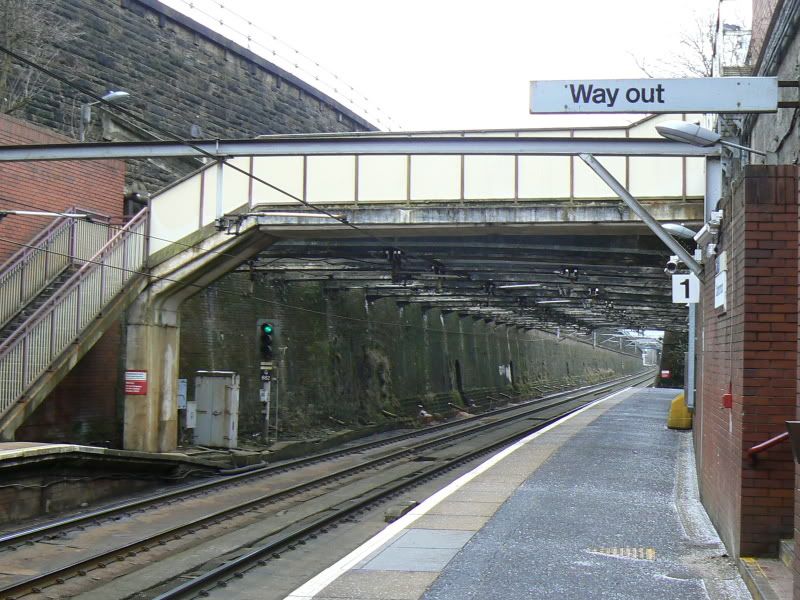
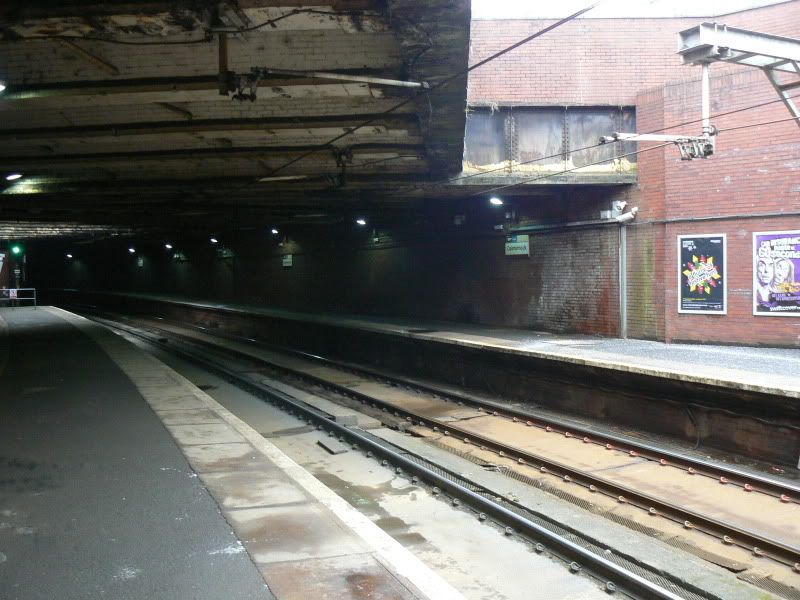
£2.8m for Dalmarnock Station!
As you can see from the photos, there's a lot of improvement to be done, and works will need to get underway soon to ensure the station is ready for the Commonwealth Games in 2014.
This station has been neglected for many years, and I'm glad to see that it's being brought up to scratch by an SNP Government. This will benefit my constituents, people travelling to the area for the Games and the football, and local businesses.
Scottish Government press release:
Dalmarnock Station in Glasgow's East End to be redeveloped European funding of 2.8 million pounds is being invested in a project which will help support the redevelopment of Dalmarnock Rail Station in Glasgow's East End.
John Swinney, Cabinet Secretary for Finance and Sustainable Growth, announced the funding package for the station, which will be a key transport hub for the Commonwealth Games in 2014.The work at Dalmarnock will offer commuters more travel choices through the heart of the Games village and help meet travel demands beyond the Games.
Mr Swinney said:
"The Scottish Government is working tirelessly to ensure the right infrastructure is in place to support sustainable economic growth. That's why I'm delighted to announce this 2.8 million pounds investment from the European Regional Development Fund which will help support the redevelopment and refurbishment of Dalmarnock Station.
"When delivered, the station will not only provide additional transport services for the Commonwealth Games, but also help support the regeneration of the wider Dalmarnock area.
"As we look forward to the Games in 2014, this investment will help deliver an efficient transport network for visitors to the city, as well as a lasting legacy of improved transport links in Glasgow's East End."
Background Project Partners delivering Dalmarnock Station refurbishment are Transport Scotland, Glasgow City Council, Strathclyde Partnership for Transport, Clyde Gateway and Network Rail. Project partners are currently working up preferred options for the station redevelopment. This work is progressing well for delivery in 2013. The ERDF contribution towards the funding for the scheme has been confirmed as 2,859,500 pounds.
Tuesday, 2 March 2010
More police on the beat, fewer crimes
At the end of 2009 there were 17,273 police officers in Scotland – 1039 more than when the SNP came to power, and 1272 more than in 2005. This record number is reflected in the Community Police in my own ward, who have been popping into my surgeries to say hello and keep me updated on what's been going on. There are a lot of faces and names to remember! They now cover smaller geographical areas, and are getting about on foot and on bikes to see and be seen.
It's not just my ward that's been so well covered - every single Police Force area in Scotland has seen an increase in the number of police officers. This is due to record funding for police recruitment under the SNP, and has helped crime rates hit a 30 year low.
I suppose in this context, the news yesterday that youth offending in Glasgow has dropped by almost a third in the past two years shouldn't be a surprise. Glasgow's Youth Justice Strategy Group has been diligently working away all the while when Labour have been screeching and fudging. The Intensive Monitoring and Support Service is an alternative to jail for young people, and re-directs them from a life blighted by a cycle of re-offending, anti-social behaviour and crime.
According to the Evening Times:
The number of under 18s in Glasgow identified by Strathclyde Police as having committed an offence last year:
Attempted murder, serious assault, robbery, threats – 343 (down 11%)
Indecency – 39 (down 35%)
Housebreaking, theft, fraud, other dishonesty – 1541 (up 3%)
Fire raising, vandalism, malicious mischief – 1209 (down 15%)
Possession of offensive weapon, knife carrying, drugs offences – 2476 (down 17%)
Petty assault, breach of the peace, consuming alcohol – 6782 (down 5%)
Driving offences – 396 (down 20%)
Total – 12,786 (down 9%)
Yes, that's right - instances of young people carrying an offensive weapon or getting involved in drugs are down a massive 17%. Coupled with the work being done by CIRV, I think that should be commended, and Labour should be ashamed at their opportunistic scaremongering. Of course there's still a lot to be done, but the figures show real progress. Well done to all involved.
Friday, 15 January 2010
Is this what it takes for Labour to take notice?
As readers may recall, Labour had nothing whatsoever to say about organised crime back in Glasgow City Council in November.The SNP group put down a motion, and Labour Councillors childishly refused to turn up to the meeting.
The SNP Government has been working hard to tackle organised crime at many levels, and the Cashback initiative has also sought to turn the proceeds of crime into benefits for local communities.
When organised crime is allowed to grow, ordinary people suffer. It shouldn't be that members of the public risk getting caught in the crossfire when they're out to get their messages. Since the shooting of a man earlier this week at lunchtime in the car park of a Glasgow supermarket, Labour MSP Paul Martin has found something to say on the matter.
Paul Martin (Glasgow Springburn) (Lab): Yesterday, in broad daylight, a man was shot dead outside one of Scotland's busiest supermarkets in the Robroyston area of my constituency. Does the First Minister agree that the time is now right for the Parliament to show leadership by standing up to such unacceptable gangland activities? Will he arrange for the Cabinet Secretary for Justice to meet me and anyone else who has an interest in the issue to discuss how we can take the most effective action to deal with the unacceptable activities of the gangland networks?
The First Minister: The justice secretary will be delighted to attend such a meeting with the member. I know that the member will want to support the initiative on the serious organised crime task force, which is designed precisely to address such behaviour across society. That task force is long overdue, but now that it is coming into being as part of our battle against organised crime, it deserves the support of every member.
I do hope Mr Martin has been in touch with his colleagues in the Council to make sure they're on board...
Tuesday, 8 December 2009
Extending freedom

The proposed changes are due in part to the creation of organisations such as Culture and Sport Glasgow; many formerly Council-run services across the country have moved out of direct Council control to arms length external organisations, and technically also moved out of reach of FOI. It's logical and reasonable to repair this anomaly and ensure that these services remain accountable and provide good value for money.
A bone of contention for many people in Glasgow was the GHA's similar exemption from FOI. They receive and spend vast sums of public money, but thus far have not been open to full scrutiny from the public at large. It's true that other social landlords are also exempt, but none are so monolithic as the GHA - the press release makes mention that, for the others, transparency may be dealt with under the Housing (Scotland) Bill.
I'm glad also that PPP/PFI contracts - which I don't even get to see properly as a Councillor - may also be subject to the extended legislation. When colleagues asked to view the Glasgow secondary schools documentation, they were only allowed to view the contract itself and take notes while supervised by Council officers. Commercial confidentiality, apparently. How we're supposed to establish value for money is a bit of a mystery, so I really hope that this can be opened up.
Bruce Crawford MSP:
It is important that organisations who deliver key public services for the people of Scotland operate transparently so the public can be reassured we are getting high quality services and value for money. I am also sympathetic to the view that people should be able to 'follow' the expenditure of public money through their access to information, in particular in relation to PFI/PPP contracts which tend to be high value and long term."
Information Commissioner, Kevin Dunion:
"I am pleased that the public's right to information is being protected and in some cases extended by the Scottish Government's proposals to bring bodies like local authority trusts, private prisons and PPP contractors within the scope of the Freedom of Information Act.
I will use the period of consultation to argue that the right to information is not an unreasonable burden. There is no evidence of any material damage to commercial interests or public procurement from FOI disclosures in Scotland over the past 5 years. It needs to be accepted that where substantial sums of public money are being expended then the public should have right to know. Freedom of information should follow the public pound."
The consultation should be underway in Spring next year.
Sunday, 6 December 2009
Reporting from SNP National Council
The presentation given on the Your Scotland, Your Voice by Nicola Sturgeon was interesting, and I particularly liked the video presentation which put the referendum into a historical context, tracing the key moments in Scotland's history. There's a slightly different version of this on the National Conversation website. Nicola opined that, instead of using Labour's recession as an excuse for delaying the referendum, we should use it as another example of why the Union is not working for Scotland. If we want to really change Scotland for the better, for the benefit of our people, we need access to all of the powers to allow us to do this.
Nicola's presentation was followed by a longer-than-scheduled speech by Alex Salmond. His speeches at National Council tend to be less formal than those at Conference - the size and layout of the hall at the venue also means that if you're foutering about with your blackberry, you're more apt to be spotted! The speech touched on quite a few different areas; the historical context of the struggle for Scottish independence, the respect the SNP government is gaining worldwide, the hypocrisy of other parties' positions on referenda, the importance of the Westminster elections next year, and, as covered in some press today, he mentioned bloggers.
The international context was interesting - on Climate Change, there's obviously the controversy about the Scottish Government not being allowed to go to Copenhagen. We have something important to say, but don't have the ability to debate on equal terms with other nations. Alex made the point that while plenty of politicians and governments are prepared to negotiate for dates in twenty, thirty, fifty years time, to legislate for reductions in 2020 (when a good number of our politicians will still be around and with any luck still in office) is pretty brave. Recognition is also there in our wealth of opportunity in renewable energy, but the UK Government's rules on grid transmission charges mean that we are constrained in developing these technoligies. Our stance on nuclear weapons is also internationally recognised, but without independence we are unable to prevent their presence on our shores.
The support Gordon Brown has given for a referendum on the Alternative Vote was noted (well done on picking a system experts such as the Electoral Reform Society don't want!) as well as their support for a referendum in Wales. The Lib Dems have variously called for and rejected referenda on a range of issues, and the tories found they had to change their mind. Given all of this background, it seems odd that these parties would line up in opposition to giving Scotland's people a choice. What always gets me is that these parties claim that no one supports independence - if they truly believed that, then why are they so scared to test it?
As for the Westminster elections... as I've said before, we have a wonderful slate of candidates. I can vouch for the ones I know personally, and know that they are people with strong social conscience, and a belief in helping to make Scotland a better place. When elected, they will represent their constituents with dilligence and compassion. They are working very hard to get known and get elected next year. They want to make a difference and make Scotland's voice heard.
Moving on to being heard, and what didn't get reported from Alex's speech. He expressed a disappointment with Scotland's media, and predicted that the number of publications would reduce by half in the ten years ahead. He noted that the commerical interests of our press at present did not allow them a distinctive Scottish voice; this was resulting in a decline in circulation and influence in society. I often wonder why, when we have an SNP government and the largest number of Councillors in Scotland, we fail to get fair coverage. You would think it would be in the interests of the press to reflect the changes brought about by their readers since 2007...
I suppose this is where responsible bloggers come in. Salmond did comment on bloggers, but the purpose of blogging and it's place in the media of our nation was his main point, not telling us off. SNP-supporting bloggers have a duty to make the positive case for independence, the one our media fails to make, and "leap over" the dead tree press. We must make the case they are failing to print.
Independence is all about positivity and ambition for our country and our people. It's a compelling case, and I will continue to get it out there in every way I can.
Monday, 21 September 2009
Voting for the future
It's consistent and logicical therefore that the SNP advocate a vote for this age group in the independence referendum. This has recently been confirmed by Michael Russell in a letter to Scotland's youngest MSP, Aileen Campbell. Fellow blogger Euan Purchase made the initial inquiry, which he talks about here.
Linda Fabiani put across the case succinctly and reasonably on the Politics Show on sunday, saying:
"We have young people in this country who really are in tune with politics, they are entitled to get married, they pay taxes, why can't they vote?"This referendum's about Scotland's future - these young people are Scotland's future, so, to me, it's perfectly logical, perfectly right they should be asked to vote in this referendum."
By contrast, Pauline McNeill looked sour and petty, giving no real reason why not. She denied it was because young people might be more inclined to support indepenence, saying this view was predominately held by older men. The suggestion by Jeff that the principle is the main thing seems to have escaped Ms McNeill.
All the arguments against this proposal seem to be forgetting that extending the franchise has been our policy for years, accusing us of opportunism, and some even practially suggesting the idea is invalid because it's come from the SNP. According to the Votes at 16 coalition's website, it's also the policy of the Labour party and the Lib Dems, not that you'd know it from their responses.
Reform of the voting age has been on the agenda for ages, out for consultation and a response made, but I would very much doubt that Gordon Brown will agree to any changes before the General Election. Labour have had twelve years to change this, and have delivered nothing at all. The taxes paid by those under-18s over the years must be quite considerable by now.
The newspapers also seem to hum and haw curiously over the issue, taking the Labour line on opportunism - yet surely if any party suggests extending the franchise, this could be seen as a chance to woo younger voters? Given that there are elections almost every year, when is the right time to extend the voting age? If you were to follow the sore-bum-from-sitting-on-the-fence-so-long line of the newspaper editorials, the real opportune moment for our disenfranchised young people will never come.
The Press and Journal:
"There is much to be said for involving people at a younger age in the voting process, but that should be taken in the round and not on one narrow stage."
The Scotsman:
"There is a serious case for lowering the voting age, but it should be debated in depth, as a major constitutional reform, it should not be different for different votes. This move, despite the strong arguments in its favour, should fall simply because it is political opportunism."
The Herald:
"There are sound arguments for enfranchising 16-year-olds. The decreasing turnout at elections is a democratic deficit which must be put right and engaging young people at an early age is the best hope for the future, but party politics should never dictate such a significant change."
*UPDATE* I've just come across Joan McAlpine's rather excellent blog, which has this article quoting Gordon Brown's views on Votes at 16. Demonstrates Labour's opportunistic hypocrisy on this issue rather well!
Tuesday, 25 August 2009
Kenny was right
I've been following the Lockerbie coverage, and have had discussions with a few people over the past weeks, political and non-political about Kenny MacAskill's decision to release Megrahi on compassionate grounds. The consensus is that a) he was right to do so and b) it was an incredibly difficult decision given the intense pressure and scrutiny placed on him.I was disappointed but not surprised by the way the opposition MSPs (Malcolm Chisholm aside) conducted themselves. They asked the same tired questions again and again, all eager to get a piece of the action. As Ian Gray himself admitted on Newsnight last night, they came out of the session with no further information than when it began. What purpose did that serve? Calling on the Justice Secretary to change his mind was hardly likely to be successful either. It was a bit of show; Ian Gray, Tavish Scott and Annabel Goldie trying to show that they had opinions and would have acted differently, when in reality, it was impossible to have done so. I have spoken to some Labour people, and they do support the position Kenny took; their party loyalty of course prevents them from saying so.
I hope that now everyone can move on - I hear that there's likely to be another debate in Parliament next week, and I hope that those involved yesterday will think hard about what they wish to achieve. The decison is made; Megrahi will die, and it's time for the opposition in Scotland to put away childish things.
Sunday, 4 May 2008
One year on
When we left the SECC, squinting into the sunshine, we didn't know whether there would be an SNP government. We knew that our numbers in Glasgow City Council had gone up from four to twenty-two, that every candidate we had stood had made it and that was amazing enough. In the weeks and months before the election, even that had seemed unlikely - I remember my boss of the time looking at previous election results in the old wards with me and saying it was a long shot. Nevertheless, we'd all made it.
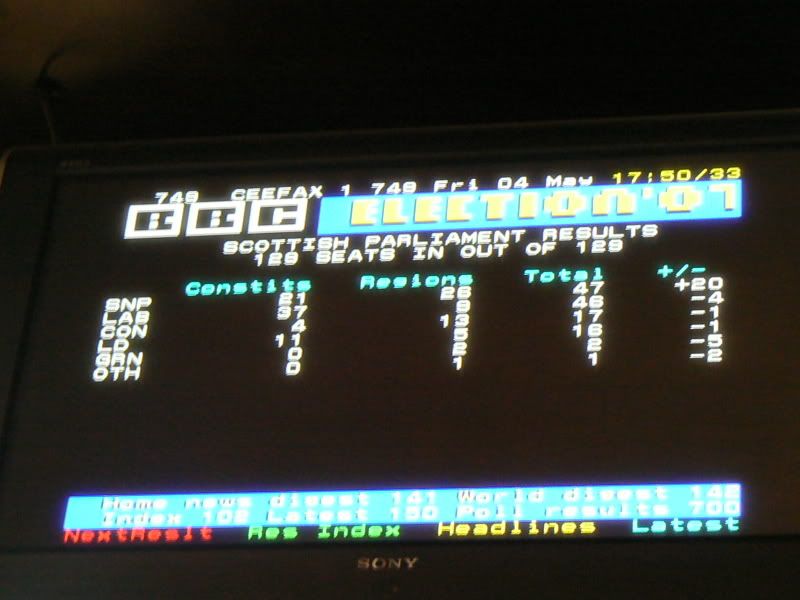
We were all in the Ben Nevis when I got a call from my dad. He was driving home from work and had just heard on the radio that we'd won the election. I went back into the pub, not quite believing and not sure whether to tell everyone in case I'd got it horribly wrong. I told them. We were all nervous. And then, in this age of instant news and global communications... the result came up on ceefax.It's been a short year - I can't believe how quickly it's flown past. It's also been a learning curve. It's not for me to say how I'm doing, but I do hope that the people that I've helped feel that I'm making a difference for them. I'm still as excited and proud today as I was on the 4th of May 2007.
Monday, 28 April 2008
Calman - what's the point?
It's also curious that Labour, the Lib Dems and the Tories, despite having varying positions (even within their own parties) on devolution and independence have come together in this way. When the Prime Minister says the review is not a "one-way street", can other parties have confidence in the direction of the Commission? Will they be able to come to an agreement? What kind of outcome will satisfy all of them? Surely it's just a total waste of time if it doesn't actually propose much in the way of change?
Pete Wishart addressed both of these points well in a recent debate in Westminster:
The Liberal party must make it abundantly clear to Labour Members that it is not prepared to go through with the process unless it gets a cast-iron commitment and guarantee that there will be no taking away of powers from the Scottish Parliament to Westminster. We all look forward to hearing that from the hon. Member for Argyll and Bute (Mr. Reid), who will be speaking for the Liberal party. No one believes that there is any requirement for a return of powers to Westminster: it exists only in the fevered imagination.The biggest problem with the commission—there are many—is what I would call the democratic deficit. The only thing that it will not consider is independence. If it is to consider Scotland’s constitutional options, it is absurd and inconceivable that independence should be left out of a review of further powers for the Scottish Parliament. What are Labour Members afraid of?
What indeed. Perhaps losing their lovely Westminster privileges...
Ahem.
The Commission, is made up of the following carefully selected individuals (I would go into details, but I see that Jeff and Calum have beaten me to it):
Sir Kenneth Calman, Chancellor of the University of Glasgow (Chair)
Colin Boyd, former Lord Advocate, member of the House of Lords (Labour)
Rani Dhir, Director Drumchapel Housing Co-operative
James Douglas Hamilton, former Scottish Office Minister, member of the House of Lords (Conservative)
Professor Sir David Edward, retired Judge of the European Court
Lord Elder, member of the House of Lords (Labour)
Audrey Findlay, former Leader of Aberdeenshire Council, now Convener of the Scottish Liberal Democrats
Jamie Lindsay, former Scottish Office Minister, member of the House of Lords (Conservative), Chairman SAC (Scottish Agricultural College)
John Loughton, President of the Scottish Youth Parliament (serving in a personal capacity-that would be because the SYP doesn't allow for party politics...)
Murdoch MacLennan, Chief Executive, Telegraph Media Group
Shonaig Macpherson, Chair of the National Trust for Scotland and of the SCDI (Scottish Council Development and Industry)
Iain McMillan, Director, CBI Scotland
Mona Siddiqui, Professor of Islamic Studies, University of Glasgow
Matt Smith, Scottish Secretary , UNISON
Jim Wallace, former Deputy First Minister and former leader of the Scottish Liberal Democrats
At least we have the good manners to invite some of their lot over to play...
Tuesday, 22 April 2008
Busy busy Friday
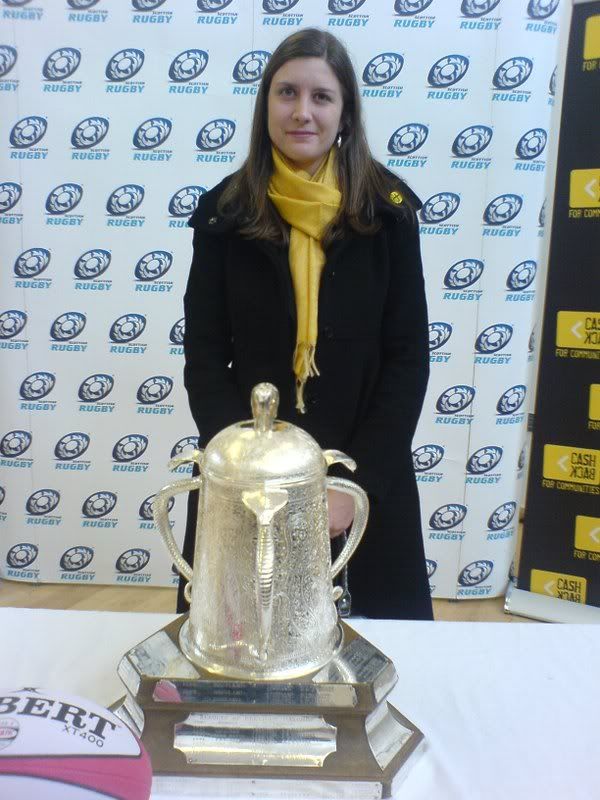
If the rest of the week was busy, Friday was manic.At 10am, I attended the latest announcement of money in the CashBack for Communities at the East End Healthy Living Centre in my ward.
This scheme takes money from the proceeds of crime and returns it, in this case through rugby, to
keep young people out of trouble.This latest phase of the scheme will:
"..use over £1.4 million seized from serious organised criminals to provide free rugby coaching and playing activities for over 32,000 young people throughout the country by 2011.
The Scottish Government has brokered agreement with Scottish Rugby (the SRU) to deliver a comprehensive three year programme across Scotland to encourage participation by young people in rugby."
I'll be asking the SRU what money is heading to Glasgow, and I hope it will be possible for some to come to my ward.
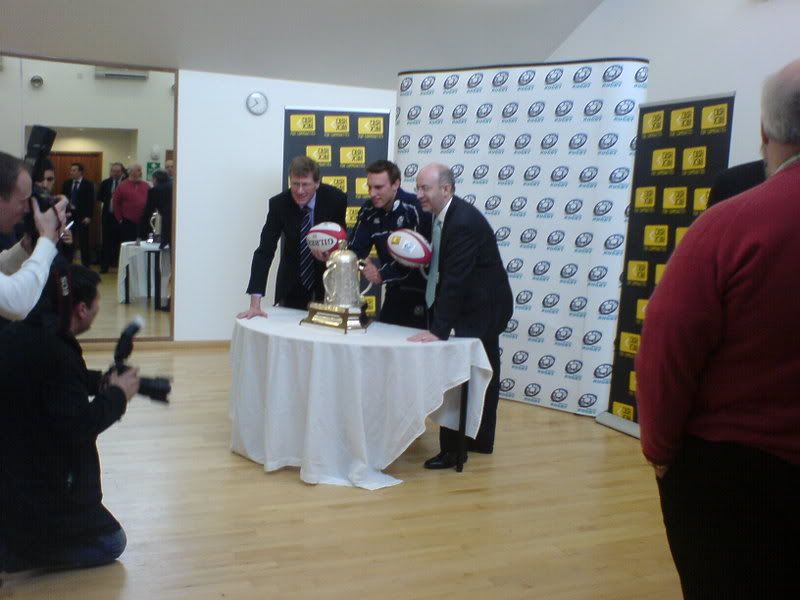
The unexpected surprise from the announcement for me was the presence of several rugby players, and the very beautiful Calcutta Cup. Not sure if it was the real one or the replica, but I felt lucky to get to stand near it - I say stand near, because there was no way I would have been allowed to touch it! The Cup is pretty fragile partly due to age and some shenanigans on Princes Street.
After the brief brush with sporting glamour, it was back to the reality of Council with the fortnightly Executive Committee. My mum and my cousin had come to sit in, and there was certainly plenty to hear, including A response to the Scottish Government consultation on elected health boards and the Scottish Climate Change bill, papers on the future of LES trading operations and Direct and Care Services, and a paper on the funding of Area Committees.
After lunch, we went to finally put down a deposit on the wedding venue and to look at shoes and tiaras. It's been tricky to get a date when we could all get together, so it was nice to finally start looking at putting the wedding together. It's pretty weird to have it going from a far-off concept to realising that (according to my bebo countdown clock) we get married in a hundred and eight days!
I couldn't look round the shops for long, as I had to rush off to Edinburgh to catch the end of the SNP Councillors conference. It seems to have been a very useful event, with lots of workshops. We're all so busy getting on with being Councillors, it's not really been possible to catch up with what's been going on in other groups across the country. It was also good to geek out with a different set of people purely about our different experiences and swap stories and tips. It was a good kick-off for Spring Conference too, more of which later.